
 How can EU law help an adviser determine someone’s entitlement to social assistance, a pension or disability support? And how can a judgment of the Court of Justice be translated into practical advice for a citizen?
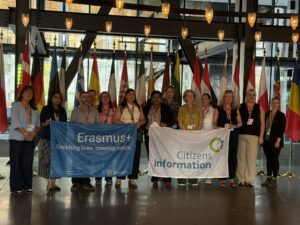
These were among the questions explored when the European Institute of Public Administration (EIPA) welcomed colleagues from the South Leinster Citizens Information Service to Luxembourg from 7 to 11 September 2026.
The Erasmus+ study visit was designed around the advisers’ daily work: helping citizens navigate social welfare and employment-related issues that may involve EU rights and legislation. By working with real-life legal questions, participants were able to connect EU law directly to the situations they encounter in their communities.
From EU principles to practical advice
On the first training day, participants built a practical understanding of the foundations of EU law. Together, they examined its main sources and principles, the differences between directives, regulations and decisions, and the circumstances in which EU law can be relied upon in national casework.
They also considered the role of the CJEU in the EU and national legal orders and considered how the EU Charter of Fundamental Rights applies to social welfare cases.
The discussions then moved to issues familiar from the advisers’ own work: residence rights, access to social assistance, pensions, disability and age-related entitlements, and equal treatment. Case studies enabled them to test how EU rules on labour mobility, non-discrimination and the coordination of social security systems apply in practice.
A dedicated workshop helped the participants develop practical techniques for reading and using CJEU judgments in social welfare cases, drawing on relevant case law on residency rights and access to benefits.
Tackling employment and free-movement questions
The second training day shifted the focus to employment law, with particular attention to non-discrimination, equality and the free movement of workers.
Participants explored the coordination of social security systems under Regulation (EC) No 883/2004, equal treatment and worker protection, as well as CJEU case law on labour mobility. They also discussed practical challenges that arise in employment-related casework, including gender, disability and age discrimination and the rights of EU citizens and their family members.
Rather than ending with theory, the team brought the different strands of the training together in an EU law toolkit for the South Leinster Citizens Information Service. The toolkit combines useful legal resources with practical approaches that advisers can draw on when supporting citizens after their return to Ireland.
Charles O’Sullivan, Assistant Professor in Law at Maynooth University’s School of Law and Criminology, delivered the training in collaboration with EIPA and representatives of the South Leinster Citizens Information Service.
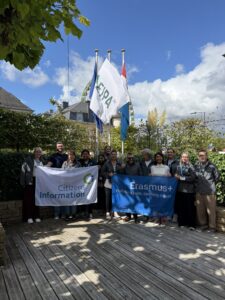
Visit to the Court of Justice of the European Union
A full day at the Court of Justice of the European Union gave the visitors a different perspective on the law they apply in their work.
They attended a briefing and hearing of Case T-148/25 Ryanair v Commission, concerning State aid measures relating to Frankfurt-Hahn Airport. They also explored the Court’s buildings and library before meeting Judge E. Regan of the Court of Justice and Judge C. Mac Eochaidh of the General Court.
Meeting the two judges allowed the advisers to discuss how judicial proceedings work in practice and to connect what they had learned in the classroom with the people and institutions responsible for interpreting EU law.
By the end of the visit, the South Leinster team had not only strengthened its knowledge of EU law. Its advisers returned with practical methods, resources and first-hand institutional insights that can support them when helping citizens understand and exercise their rights.