
Slovenia’s CAF Journey: From Self-Assessment to Organisational Excellence
 In the face of the constant challenges confronting the public sector in an increasingly complex environment, it is important to recognise that, with the help of the CAF model and self-assessment processes, public sector organisations are moving in a positive direction — not through tectonic shifts, but through small yet persistent steps forward. Leaders who, over the years of the model’s existence and development, have understood its essence and its power to foster positive change in management, processes, and people, also recognise its potential for the development of the organisations they lead.
To date, more than 140 public administration bodies and public sector organisations in Slovenia — in education, healthcare, employment services, culture, and other fields — have chosen the path of change with the CAF model in their hands. Many of them carried out their first self-assessments as early as 2002 and 2003, and have continued to conduct regular CAF self-assessments every few years, adapting them to the continuously evolving CAF model.
A new impetus to these processes was provided by the European Cohesion Policy project “Introduction of Quality Management Systems into Public Administration”, led by the Ministry of Public Administration between 2017 and 2023. Within the framework of the project, a system was established for the systematic support of CAF implementation, with the Ministry of Public Administration acting as the National CAF Resource Centre, as well as a support system for carrying out the CAF External Feedback Procedure (CAF PEF). From the beginning until today, 27 public sector organisations using CAF — including administrative units, ministries, institutes, a healthcare centre, and a library — have successfully completed the CAF PEF external feedback process.
In Slovenia, a network of CAF users has been established, sharing both positive and less positive experiences of CAF implementation among organisations. This network also includes CAF External Feedback Actors (EFAs), who act as promoters and ambassadors of the CAF model. As experts with extensive experience in CAF self-assessments within their own organisations, as well as in the CAF external feedback process, they support organisations and provide guidance in implementing improvements.
The CAF external feedback system in Slovenia is active and functioning effectively.
CAF in the Ministry of Interior
This time, we would like to highlight the example of the Ministry of the Interior, which sought to validate its latest CAF self-assessment through the CAF PEF process last year. The assessment team, composed of four members from three different ministries and one body within a ministry, recommended in its report, among other things, that the self-assessment process be extended to other parts of the ministry and to bodies within its organisational structure. Based on this initiative, representatives of the national CAF Centre presented the CAF model and its advantages at an extended meeting of the Minister of the Interior’s management board, where the implementation of CAF in the mentioned institutions received strong support from top management.
As a result, this year, in addition to the Ministry of the Interior itself, CAF self-assessments are also being conducted by the Inspectorate for Internal Affairs and by two specialised units of the Police: the National Forensic Laboratory and the Police Aviation Unit. These units were not selected by chance, as their staff already possess valuable experience with international quality standards and assessment procedures due to the nature of their work.
Each year, the Ministry of Public Administration organises CAF training sessions for all members of self-assessment groups and CAF project leaders. The training consists of 10 teaching hours over two days and includes both theoretical content and, in particular, highly practical elements related to the introduction and implementation of CAF self-assessment, the preparation of reports, and above all the preparation of improvement action plans — the core of organisational improvement processes. The training is delivered by highly experienced CAF experts who support participants with extensive knowledge and many years of practical experience. Participation in the training is free of charge.
This year, interest in implementing the CAF model in public organisations has been considerable. A total of 22 organisations registered for implementation and enrolled 130 participants in the training sessions. To ensure the best possible learning experience, training groups are limited to no more than 20 participants. Participants from the same organisation are given the opportunity during the training to conduct trial assessments of one or two CAF criteria. Together with the trainers, they subsequently evaluate the relevance of their assessments and improvement proposals, while also discussing common mistakes typically made by inexperienced teams.
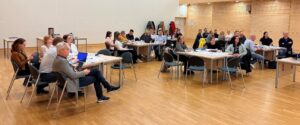
Due to the specific organisational structure of the Ministry of the Interior, the Inspectorate for Internal Affairs, and the Police, CAF training sessions were organised separately for two groups comprising 44 representatives of these institutions. Before the start of the training sessions, participants were addressed by the Deputy Director-General of the Slovenian Police, Mr Beno Meglič, who stated, among other things:
“In police operations, assessing the quality of our work is not merely a formality or an administrative novelty, but a clear signal of our commitment to excellence, accountability, and continuous improvement. I am aware that every change also brings questions and perhaps doubts. However, I believe that within the police we possess the knowledge, experience, and dedication necessary to successfully carry out this process. CAF is not an end in itself, but a tool that will help us become even better — as individuals, as an organisation, and as guardians of public safety. As an institution, the police bear an exceptional responsibility towards society. Our work directly impacts people’s safety, public trust, and the functioning of the rule of law. We must be prepared to regularly evaluate our work, identify opportunities for improvement, and respond to the challenges of modern times in a professional, efficient, and transparent manner. The CAF model provides us with a structured and proven framework for doing so. It offers a comprehensive insight into our operations — from leadership and strategy to the management of employees, resources, and results. Its greatest value, however, lies in the fact that it promotes a culture of self-reflection, cooperation, and the collective search for better solutions. Successful implementation requires a high level of commitment from leadership, which must be actively involved in the process, recognise the added value, ensure an open environment of trust, respect the results, and encourage improvements. Yet employees themselves are the most important factor. Your experience, your proposals, and your willingness to cooperate will be decisive for success. Therefore, I encourage you to work together as an effective team capable of preparing a credible internal picture of the organisation. Approach the implementation openly, constructively, and with the common good in mind. Our vision remains clear: to be a professional, trustworthy, and efficient police service acting in the interest of all people. The CAF model represents one of the important steps along this path.”
Following the completion of the training sessions, the organisations have already begun their self-assessment activities, supported professionally by a two-member team from the Ministry. By early autumn, self-assessment reports and draft improvement action plans will be completed, followed by internal coordination processes and approval by management. Organisations that submit evidence of the approved improvement action plan to the Ministry will receive official recognition at a special ceremony at the beginning of 2027.
Contact details:
Loredana Leon, podsekretarka, Ministry of Public Administration, National CAF Correspondent, Slovenia Loredana.Leon@gov.si
Barbara Zupanc, sekretarka, Ministry of Public Administration, Directorate for Quality, Barbara.Zupanc1@gov.si
photo credits: Suzana Rudež